Woodstock for Capitalists ’22

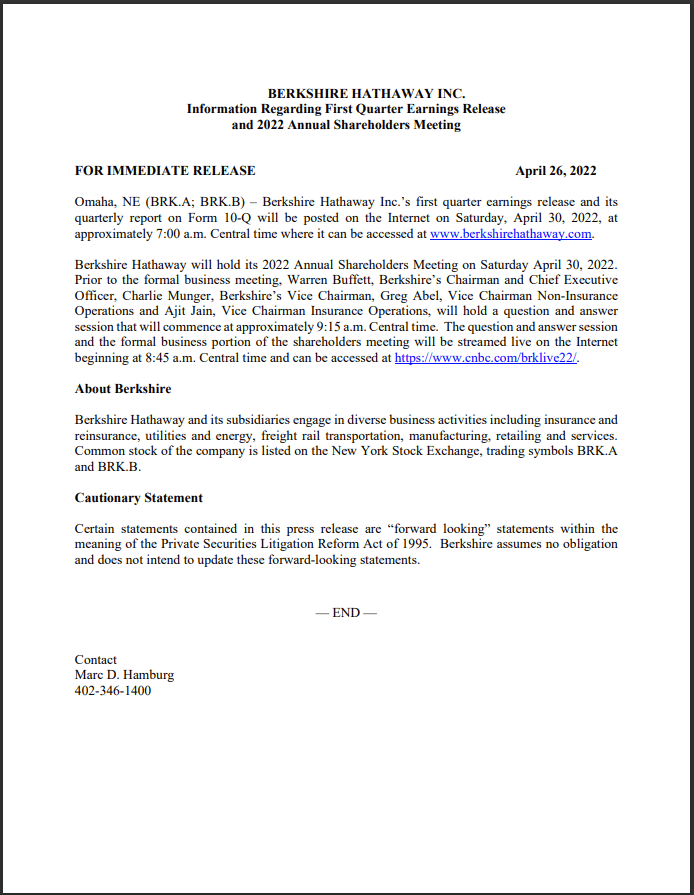
We are now less than 48 hours away from the 2022 Berkshire Hathaway Annual Meeting, aka “the Woodstock for Capitalists.” The meeting begins Saturday morning at 6:45 am (pacific) 8:45 (central) and it can be viewed by clicking this link: https://www.cnbc.com/brklive22/

I regret I won’t be traveling to Omaha this year. I’ve been to several meetings since 2001 and the Berkshire AGM is always a fun event. In addition to hearing Warren Buffett and Charlie Munger live, there are countless events happening around town (Nebraska Furniture Mart Bar-B-Cue), the Friday night Borsheim’s reception, etc.

Then, there are the “Berkshire company” displays and booths in the exhibit hall offering shareholders tremendous value on everything from boxer shorts (Fruit of the Loom) to gourmet chocolates (See’s Candies), kitchen utensils (Pampered Chef), air compressors (Campbell Hausfield), car insurance (GEICO), Buffett Books (the Book Worm), cowboy boots (Justin Brands) and luxury manufactured homes (Clayton homes). It’s festive and the booths are staffed by midwestern sales staff who know their craft.

You never know who you’re going to see. “That’s Bill Gates eating a Dilly Bar.” “That’s Susan Lucci buying jewelry at Borsheim’s.” “That’s Bill Ackman at the microphone.” “That’s Lou Simpson…” RIP

There are receptions hosted by other reputable investors and Berkshire disciples including the Markel brunch reception at the Marriott on Sunday morning. See: https://youtu.be/F_OnccXU8ZU  One of these years I will have the pleasure of meeting Tom Gayner – the Markel sage from Richmond, VA.

Whitney Tilson will host his annual cocktail reception on Friday night https://www.eventbrite.com/e/whitney-tilsons-cocktail-party-before-the-berkshire-hathaway-annual-mtg-tickets-308282921517  

This AGM will be the first since 2019. The COVID pandemic prevented a live event in 2020 and 2021. I suspect regular attendees will be happy to see everyone again.

If you’re not able to attend, you can still get yourself out of bed this Saturday morning and hear two of the world’s brightest investment minds.     

More information, visit the Berkshire https://www.berkshirehathaway.com/news/apr2622.pdf
Wal-Mart: Satisfaction Guaranteed

For those wanting to sharpen their business and investment acumen, there are few better activities than reading the stories of business owners and entrepreneurs who’ve gone before. Today, I finished reading Sam Walton’s book, “Made in America.”

Walton completed the book prior to succumbing to cancer in 1992 so it’s thirty years old. But, with $572 billion worth of sales (TTM), Wal-Mart is still dominating the world of retail (Amazon sold $469 billion, COSTCO had $196 billion). That their culture still thrives is a testament to their founder.

The book is packed with all the “down home” wisdom you might expect. It’s a bit of a look into an America from a bygone era, but full of insights from one of America’s greatest retailing promoters and entrepreneurs.

Walton had 10 immutable rules for success. They included:

  1. COMMIT to your business. Believe in it more than anyone.
  2. SHARE your profits with associates. Treat them as partners.
  3. MOTIVATE your partners (money & ownership is not enough)
  4. COMMUNICATE everything you can with your partners.
  5. APPRECIATE everything you associates do for the business.
  6. CELEBRATE your successes.
  7. LISTEN to everyone in the company.
  8. EXCEED your customers expectations
  9. CONTROL your expenses better than your competitors.
  10. SWIM upstream. Ignore conventional wisdom.

Found it interesting how candid Walton was about numbers and ratios. Mark up on all goods was typically 30% and head office expenses were never to exceed two percent of sales. Office staff were well  versed in the benchmarks.

Running a tight ship meant shareholders benefitted along with customers. Had an investor bought 100 shares at the IPO, they would have cost $1,650.00 IF those shares were simply held and never sold, by the time the book was written, those same shares would have split nine times (2:1) and had a worth of $3,072,000.00 That’s a compounded annual growth rate of 45% per annum and it doesn’t include dividends.

I was curious what those number might look like today. The stock split three more times in the 1990s (but not since). Left to grow unhindered, those same 51,200 would have become 409,600 shares (no dividends).

Today Wal-Mart closed at $154.24 /share. Those initial 100 shares would now be worth $63,176,704.00, fifty years later. That’s a compounded annual growth rate (CAGR) of 23%.

That’s quite a legacy to leave your friends, family and associates. And, it’s a great example of why buying and holding a proven winner is a prudent investment approach.

How Retiring Investors ThinK

Last August, J.P. Morgan Asset Management released “Retirement By the Numbers,” a report that examined how investors approaching retirement manage their portfolios, their income and their spending.

The report drew on a data base of 23 million 401(k) & IRA accounts. They reviewed the activities of some 31,000 people as they approached or began retirement between 2013-2018. (401(k) and IRA are retirement accounts similar to RRSP & RRIFs).

Findings

Research from the report suggested:

a) “De-risking” is common place. Three quarters of retirees reduced their equity exposure after “rolling over their assets from a 401(k) (RRSP) to an IRA (RRIF).

b) Retirees relied on the mandatory minimum withdrawal amounts when determining how much income to draw.

c) Income and spending are highly corelated. Where income amounts were increased (i.e. from social  security, pension plans, etc.) spending followed.

Retiree Profiles

The retirees studied in the report shared the following characteristics:

a) Roughly 30% of the subjects received pension or annuity income.

b) The median value of retirement  accounts was $110,000.00

c) The median investable assets were estimated to be between $300,000 and $350,000.00 (i.e. balance being held in non-registered accounts).

d) The most common retirement age was between 65-70.

e) Age 66 was the most common age to start receiving Social Security.

Other Observations

The study also recognized the following trends.

First, retirees who waited until the rollover date to “de-risk” (i.e. rebalance their portfolios) needlessly exposed themselves to market volatility and the potential for loss. For example, those  re-balancing their portfolios in April 2020 after the COVID pandemic, were still down 5-6% after the markets had recovered a year later. Retirees ought to consider rebalancing portfolios prior their obligatory rollover (age 71).

Second, the majority of retirees were using the RMD-required minimum distribution as a guide for withdrawal amounts versus basing amounts on  retirement income needs. Like U.S. IRAs, Canada’s RRIFs are also subject to a minimum withdrawal schedule that increases with age. Retirees relying on the schedule for guidance could limit or see future income amounts reduced.

Finally, 62 year-olds represent the peak year of 9.6 million baby boomers in Canada (and the greatest years of nest egg risk are between the ages of 58-66) Should they retire and de-risk en masse, Canadian equity markets will likely undergo increased downward pressure and volatility. Retirees should consider re-balancing or “annuitizing” while markets are fully valued and  prior to an increase in capital gains or interest rates.

NOTE: This blog first appeared in the October 2021 edition of the Capital Partner

the BiGGEST Retirement Risk

This past week, I viewed a webinar presentation by Tom Hegna . Mr Hegna is an economist, a “retirement expert” and author of Pay Cheques and Play Cheques and other retirement books.

During his presentation, Mr. Hegna highlighted 10 different risks unique to “retiremenThis past week, I viewed a webinar presentation by Tom Hegna . Mr Hegna is an economist, a “retirement expert” and author of Pay Cheques and Play Chequesand other retirement books.

During his presentation, Mr. Hegna highlighted 10 different risks unique to “retirement.” They included:

  1. Longevity Risk – the risk of outliving your money
  2. Deflation – the risk that goods and services might decline (like during the Depression)
  3. Market Risk – the chance of a sustained bear market
  4. Withdraw Rate Risk – the risk of drawing down too much from your nest egg
  5. Sequence of Returns – risk of a permanent capital loss by drawing funds in a down market
  6. Regulatory Risk – a change or failure in regulatory framework (governance, Madoff)
  7. Taxation Risk – a hike in current rates or the imposition of new unforeseen taxes
  8. Inflation – an across the board increase in the cost of needed goods and services
  9. Long Term Care – the risk that a senior will require years of costly palliative care
  10. Mortality – the risk of a premature death

Of all the risks he highlighted, “longevity risk” was the most critical. It’s what he called the “Retirement Risk Multiplier.” IF that risk was not addressed first, the other risks could easily become more acute.

Life expectancy is a bit of a moving target and a tough concept for most. Most people see that life expectancy is around 84 for males and around 87 for females. What people miss is that notion that these numbers represent “averages.” They shouldn’t necessarily be used for planning purposes.

There’s a 50/50 chance (i.e. 1 in 2) that one member of a 65 year old couple will live to age 92 and a 25% (i.e. 1 in 4) that one member will live to age 97.

Hegna also noted, of all the risks retirees are exposed to, longevity risk is the easiest to take “off the table.” He advises retirees to calculate their basic human needs (food, clothing, shelter, utilities, etc.), see how much is covered by CCP and OAS and to top up income with an annuity – which guarantees retirees will never run out of income nor ever take a cut in pay (recent rates can be viewed here: https://think-income.com/annuity-info/ ).

Finally, Hegna noted how most brokers and financial planners run “Monte Carlo” analysis as a means of measuring and managing “risk.” Yet, their proposals always have a  disclaimer on the bottom of the page their retirement illustrations that reads, “63% of plans fail to provide income at or after age 90.”

When the Facts Change

“When the facts change, I change my mind. What do you do, sir?

Years ago, I read Christine Richard’s book, Confidence Game: How Hedge Fund Manager Bill Ackman Called Wall Street’s Bluff.” The book told the story of how Bill Ackman and Gotham Partners went about shorting MBIA – a mismanaged and undercapitalized bond insurer.  Ackman recognized the shortcomings of the firm’s underwriting and then published his findings for all to see on the web (you can still read the paper and his critique of MBIA here: Is MBIA Triple A? (briem.com) )

Ackman withstood countless ad hominem attacks and investigations by the SEC and then NYAG, Eliot Spitzer. He stood his ground, kept to the facts and was ultimately proven right. I’ve been a fan since. How can you not be?

These days, Ackman and his team manage a few hedge funds at Pershing Square. Their portfolios are highly focused and concentrated. Countless hours of due diligence and research are completed prior to the firm committing client’s capital. Netflix was one of the names on their roster.

On Tuesday, Netflix announced lacklustre quarterly results. Most noteworthy, was the drop in the number of subscribers (-200K). Then, yesterday, Ackman announced he was selling their Pershing Square’s stake (see letter) and realizing a $400 million loss.

Because of his public profile, Ackman is an easy target. He was criticized for his positions in Herbal Life, JC Penney, Valiant and now Netflix. Detractors find easy fodder in his failings while overlooking his many successes – MBIA, CP Rail, General Growth Properties and the greatest trade of all time See: Bill Ackman’s ‘single best trade of all time’ turned $27 million into $2.6 billion — now he’s trying it again

My respect for Ackman is steady. Do the detractors really believe he should have stayed the course? I’m reminded of those words often attributed to John Maynard Keynes “when the facts change, I change my mind. What do you do sir?”

I won’t be selling my stake in Pershing Square anytime soon.

4% Retirement Rule Now Obsolete

For years, financial professionals have suggested retirees draw 4% from their nest egg as a means of drawing sustainable income. That plan – designed by Financial Planner Bill Bengen in 1994, typically included allocating 60% into equities for long term growth and 40% into cash and fixed income as a means of dampening market volatility.

In theory, a senior with $250,000 of retirement savings would allocate $150,000 into equities for long term growth and $100,000 into cash and bonds. Then, they would draw $10,000 /year (or $833 /month) from the cash portion and re-balance the portfolio annually.

That plan is now being challenged by… the individual who first advocated the 4% rule.

In a recent Wall Street Journal article, Bill Bengen suggests retirees cut spending and exercise caution with the latest surge in inflation. He suggests adherents to the 4% rule take a pay cut and roll back their drawdown rate to 3%.  (See: https://www.wsj.com/articles/cut-your-retirement-spending-now-says-creator-of-the-4-rule-11650327097?st=gmubxx8uvq6aakz&reflink=desktopwebshare_permalink )

The problem is that there’s no precedent for today’s conditions,” he said.

A recent Morningstar report recommended a 3.3% initial withdrawal rate for those retiring today. It suggested that was an optimal rate for those who want spending to keep pace with inflation over three decades and want a high degree of certainty their money will last.

As of March 1st, Canadians had $2 trillion invested in mutual funds. Roughly 1/2 of those funds were invested in balanced funds, 1/3 were invested in equities and 1/8 were invested in fixed income/bond funds. Old ways of thinking still permeate retirement income strategies and expose Canadians to

Any retirement income strategy ought to include the use of annuities. Retirees receive higher, tax favoured income and retirees can rest assured they will never have to take a pay cut. Recent rates were posted here: https://think-income.com/annuity-info/