Happy to present an updated due diligence video on Rio-Can Real Estate Investment Trust. Rio-Can is one of Canada’s largest commercial landlords. Units of the trust can currently be purchased at a discount to NAV (net asset value). Rio-Can REIT closed today at $22.83 /unit on the Toronto Exchange (REI.UN). That ‘s about a 12% discount to book value of $25.90 as reported at the end of Q3-22.
Their future looks bright and there best days are still yet to come. It’s a good deal.
Real estate investors can go at it alone developing projects – completing zoning applications, appeasing bankers, paying for legal work, etc. Or, they can purchase units, become unitholders of Rio-Can, own a pro-rata share in some of the best placed properties in the country and ride on the coat tails of some of the country’s top real estate minds.
2) Ralph L. Block – longtime proponent of REITs (real estate investment trusts) and author of Investing in REITs
Ben Graham revolutionized the investment industry by suggesting long-term investors take a business approach when assessing the value and potential growth of stock and bond securities. For him, that meant paying attention to fundamentals like earnings and earnings growth, purchase price and a number of profitability ratios.
Graham never addressed REITs in his classic investing book because they’re a more recent phenomena (i.e. modern REIT legislation was established in the 1990s).
Henry Block wrote his definitive book on REITS in 2002. In his book, “Investing in REITs,” Block introduced readers to REIT structures, types of REITs (residential, industrial, etc.) and how to decipher the balance sheet (why do we use FFO to gage REIT performance vs. Net Income?). That book was written two decades ago.
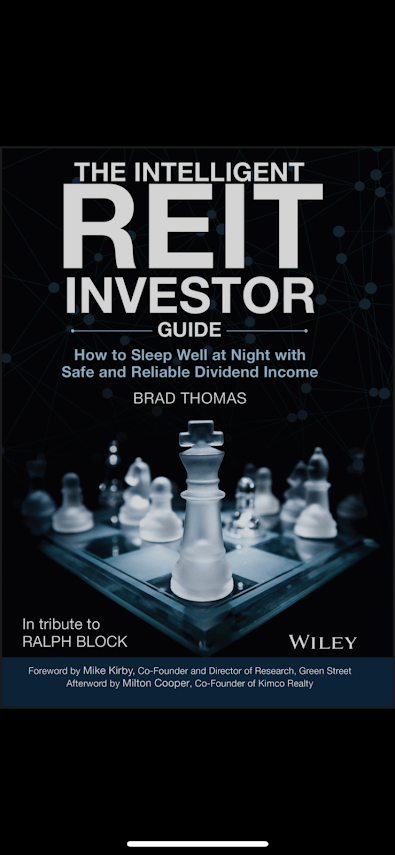
Thomas’ book does a wonderful job of combining the wisdom of both these authors and updating readers with more recent trends. Technology has radically changed the nature of home and office properties over the past twenty years and Thomas does a commendable job of leading the reader through the changes.
In this video published today on YouTube, I review the latest Q3-22 operating results from Allied Properties Real Estate Investment Trust. The Business is coping in a tough office environment and currently available at some compelling valuations.
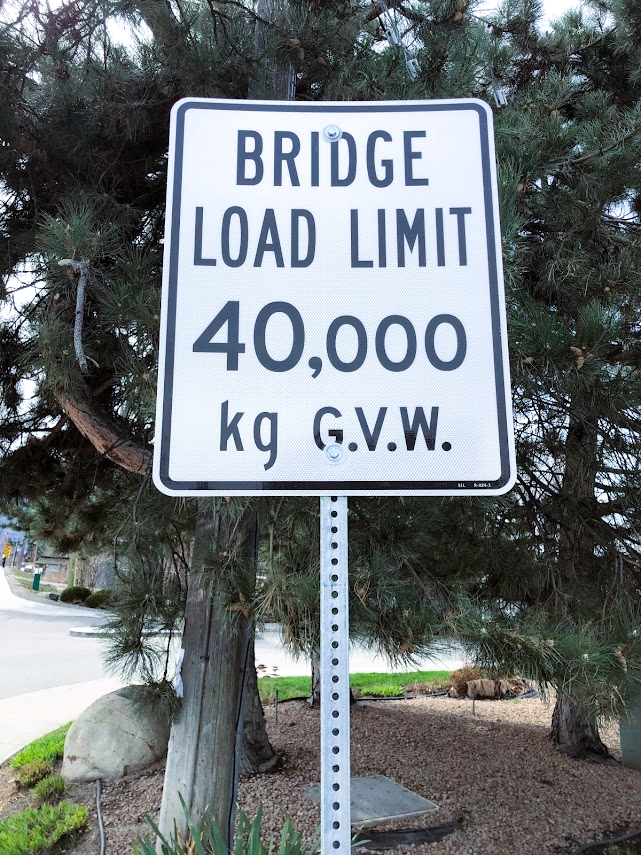
If you understood a business perfectly and the future of the business, you would need very little in the way of a margin of safety. SO, the more vulnerable the business is, assuming you still want to invest in it, the larger margin of safety you’d need. IF you’re driving a truck across a bridge that says it holds 10,000 pounds and you’ve got a 9,800 pound vehicle, if the bridge is 6 inches about the crevice it covers, you may feel okay, but if it’s over the Grand Canyon, you may feel you want a little larger margin of safety.”
Warren Buffett, 1997 Berkshire AGM
Over the past few days, I’ve been posting the first quarter operating results of top ten REITs from our property portfolio.
Most of the REITs have reported satisfactory results. They’ve all survived the pandemic and now they’re emerging as expected. Revenues, Net Income, FFO (Funds from Operations), SPNOI (Same Property Net Operating Income) and Occupancies were up for the most part. Outstanding rents have been recovered. Most are proceeding with further development of their pipelines.
A couple of exceptions bear note. Figures at H&R REIT were a bit abnormal. Last Summer, H&R REIT sold the Bow to affiliates of Oak Street Real Estate Capital. “The Bow” is one of the tallest buildings in Western Canada and it was a crown jewel in H&R’s property portfolio. Then, they spun off a large division of their enclosed shopping centres (including Orchard Park Shopping Centre). Those properties now trade as Primaris REIT (listed on the TSE under PMZ.UN). As a result, H&R’s results weren’t “normalized.”
Also, Allied Properties REIT – which focuses on Office properties had occupancies dip below 90%. Not everyone is in a hurry to return to the office. But, Allied’s brick and beam properties appeal to younger professionals – especially in the digital, high tech and telecommunications sectors. They’re desirable locations to work and they should start to see occupancies return closer to capacity.
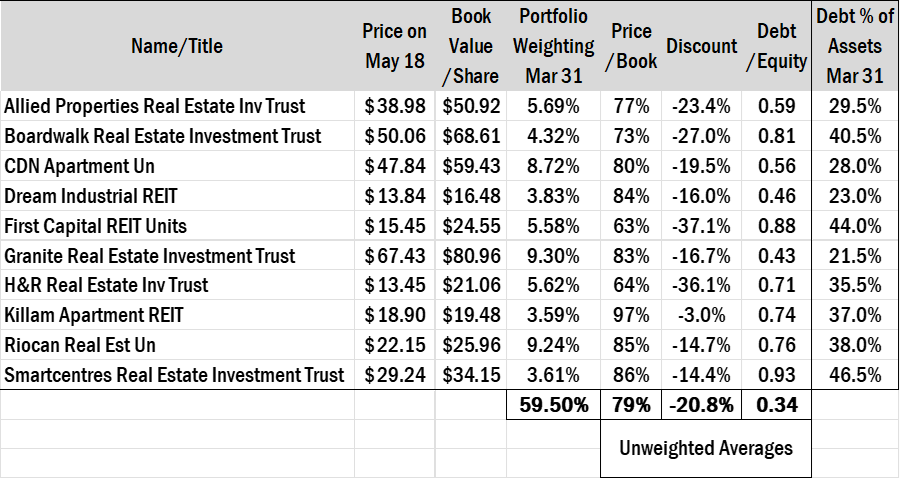
Hence, I was curious. Given that most operating results have been “normalized,” how was the marketplace valuing these REITs compared to their book value /unit – a figure that’s meant to represent current or fair market value (FMV).
The table below lists the results of my inquiry. On Wednesday, May 18, all of our REITs were all selling below book value. Theoretically, the properties could be sold into the market place and unit holders would realize a gain on the difference between the REITs unit price and the underlying assets. In some instances, those discounts were 30% or more. An unweighted average suggests the top ten holdings are selling about 20% below their fair market price in aggregate.
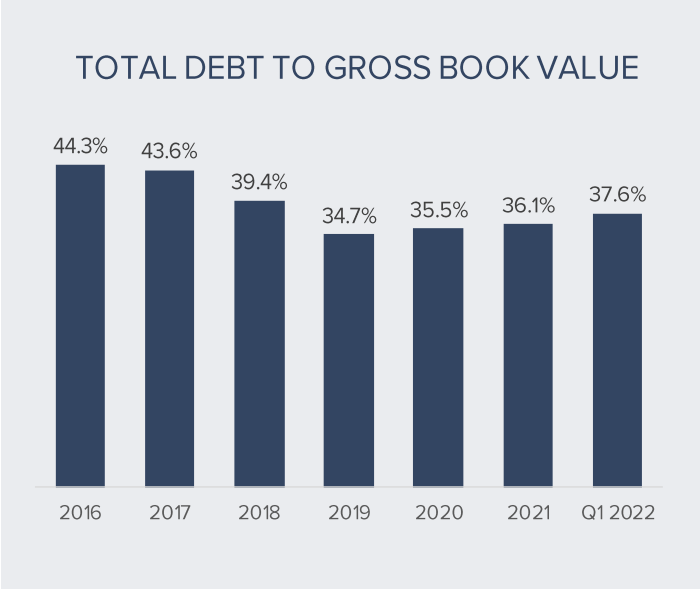
I’ve also included their debt ratios as a means of gaging how leveraged they are (higher debt levels erode unitholders’ equity during downturns). Most are conservatively financed with debt ratios ranging between 21.5% of assets (Granite) and 46% of assets (Smartcentres).
In his book, The Intelligent Investor, Ben Graham talks about 2 concepts central to his approach to investing. The first is the idea of “intrinsic value.” He suggests investing (not speculating or trading) should involve independently reviewing the business attributes of a securities issue (i.e. future cash flows, etc.) and assigning a value to that enterprise. That value might ultimately represent what a prudent or reasonable person would pay for the property or business in a private business transaction.
Then, recognizing that errors could be made with assumptions, calculations, etc., one should leave a “margin of safety” prior to committing capital. By buying at a discount to intrinsic value (i.e. a margin of safety) an investor helps to protect against downside and a permanent capital loss. It’s how one preserves capital.
It’s impossible to predict what the capital and real estate markets will do over the short term, but for patient, long term investors, a portfolio of REITs might represent a solid opportunity to enhance your and your family’s wealth.
On May 17-2022, Canadian Apartment REITs published their first quarter business results. They are the last of our property portfolio “partners” to report.
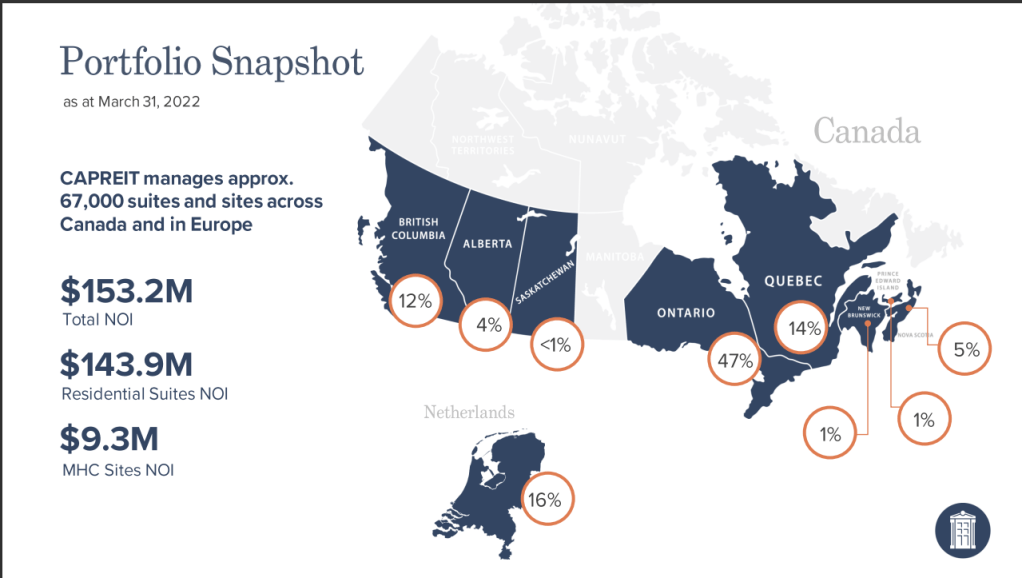
In addition to being the largest residential REIT and one of the largest holdings in our real estate portfolio, CAP REIT is also the largest landlord in Canada. Their operations are a fairly telling bell weather of the residential real estate business in Canada.
As of March 31, 2022, they reported the following results:
“Following another strong and accretive year in 2021, we continued to generate solid growth and strong operating performance in the first quarter of 2022. Occupancies rose to 98.0% at March 31, 2022, up from 97.3% at the same time last year while average monthly rents increased 3.9%. Importantly, our balance sheet and financial position remained strong and resilient with a significant liquidity position.”
“Total operating revenues increased 8.4%, driven by the contribution from acquisitions completed over the last twelve months, increased stable occupancies and higher average monthly rents. Total property Net Operating Income (“NOI”) rose 4.4% compared to the same period last year. Stabilized property NOI decreased slightly in the quarter due increased weather-related maintenance costs, higher utilities costs resulting from the colder winter this year and a significant increase in the cost of natural gas, and higher property taxes. Importantly, to date we have collected over 99% of our rents, a testament to our successful initiatives to work with our residents and understand their issues through the pandemic.
During 2021, we acquired 3,744 apartment suites, townhomes and manufactured housing community sites in Canada and the Netherlands for total costs of approximately $1.05 billion. In the first three months of 2022, we further expanded our property portfolio with the purchase of 1,015 suites and sites for total costs of $439million[1]. These new properties will make a strong, accretive and growing contribution in the months and years ahead. Looking ahead, while our acquisition pipeline remains strong and robust, we will also be examining our total portfolio to determine opportunities to generate value for our Unitholders and additional capital to fund more accretive growth opportunities.”
[1] Average cost per (apartment) units purchased in Q1-2022 was approx. $432,512.31. Average cost per units purchased in 2021 was $280,448.71. That amount includes the purchase of “townhomes and MHCs,” which would explain the lower average suite cost.
This Post is published on or around May 17th, 2022, and it includes timely information that can be quickly rendered obsolete. It is FOR INFORMATION PURPOSES and simply meant to keep partners informed about some of the holdings in our portfolios. This is NOT an OFFER to purchase securities or products & NO representation is being made. Items presented may NOT be suitable for everyone. Rates change. Values will fluctuate. Please consult an experienced, qualified, licensed professional prior to investing and ensure that your investments are a part of a comprehensive plan designed to help you & your family meet your long-term financial goals & objectives.
Gordon Wiebe is registered as a “Life, Accident & Sickness” insurance underwriter with the Insurance Council of B.C, the Alberta Insurance Council & the Saskatchewan.


 Think-Income.com